Showing posts with label Influences. Show all posts

Monday, 24 October 2011

Spooks (2002-2011)

My favorite TV series of the 2000s, Spooks, has come to an end. The series, which ran for ten seasons and 86 episodes featured the lives of MI5 officers protecting Britian from the threats of terrorism. The series was always very topical with plot lines straight out of the headlines, and one never knew when major characters would die or leave the series suddenly. Only one character appeared in every episode, Head of Counter-Terrorism Harry Pearce.


It is sad to see the series end, but sometimes I think this is a good thing, that a series ends on a high note, and will always be remembered that way. I'm glad I got to experience the series, because it certainly infuenced my writingn and what I want to write and how I want to write it. The write, ideas and plot lines, as well as the tension, was always so superb.


More informaion on the show can be found here and here.

Friday, 12 November 2010

Influences: James Bond and Bond 23

One of my favorite movie series (and novel series for that matter) is the Jame Bond films. The first introduction to the character was on television late one night when I first reached an age I was allowed to stay up late, and it was Live and Let Die, memorable for the villian exploding after he swallowed a compressed gas bullet. Then I saw Octopussy in the cinemas with the exciting jet plane race at the openning. I would have been in my early teens at the time. I was hoooked.

In awe of the amazing stunts, exotic locations, the adventurous life of a spy and the larger than life supervillians with super bases really captured my imagination. I turned to the novels and read most of them, starting with Live and Let Die and then moving onto On Her Majesty's Secret Service, You Only Live Twice, Dr. No and others, with the listed titles being my favorites. Some had supernatural elements (You Only Live Twice and Live and Let Die), others had fanciful monsters (Doctor No), all were larger than life. James Bond, Agent 007, was spy fiction series inflated into something much more, and spawned a genre of its own long before I was even born.

The movie that really made me interested in the series was The Living Daylights, Timothy Dalton's first movie in the role of James Bond. I liked it much more than what I had seen before because I found Dalton to be the most like Bond in the novels, and I also liked the movie actually taking place around real world events, such as Russia's invasion of Afghanistan back in the 1980s (dare I say Bond teamed up with the Taliban to fight the Russian's at the films conclusion). It also had a much more interesting story than anything that was released before it.

After the next film, Licence to Kill the series went in hitatus and Dalton stepped out of the role. When Brosan relaunched the series in 1995 with my second favorite Bond movie of all time, Goldeneye, I came to realise that the films were just getting better and better, although by the end of Brosan's reign it had returned to some silly ideas that were prevalent in Roger Moore's mid-career point as the 007.
Brosan was perfect for the role, I so I thought until I saw Casino Royale, with Daniel Craig rebooting the series as Bond, and in my opinion the best actor ever to portrait the character (yes, better than Sean Connery in my opinion). It was the character and film closest to the book, the story was intelligent, the acting brilliant and the women (who had been evolving slowly from Dalton's era) were multi-dimensional and fascinating characters as well as being stunningly attractive. This film is one of my favorite movies of all time. It also had style, in look, locale and feel.

Quantum of Solace which followed directly from the events of Casino Royale was also very good. In both films the gadgets are gone, also the quips and one liners that are tired now, and in their place is a more brutal world and a more brutal Bond, more realistic I guess, yet with some fantastic stunts still in there, like the construction site chase in Madagascar openning Casino Royale, which will not be forgotten for some time.

The series unfortunately has been placed on hold was MGM (the film company that owns the rights to distribution) sort out their financial problems, but it now seems that a turning point has been reached, and Bond will return in 2012. I'm excited that the series is not dead, and that Rachel Weisz might be a villian in the next film. I can't think of a better actress (or actor) to join the series.

The James Bond series influenced me most in my writing of my Harrison Peel series, a former Australia Army spy turned NSA consultant who travels the world fighting Lovecraftian horrors in exotic locales such as the Congo, Venezeula, Cambodia, Chile, Pakistan, Antarctica and others, and up against spies and terrorists who would use these Lovecraftian horrors for their own ends. I also mix a lot of theoretical physics in there, such as quantum mechanics, wormholes, time travel, string theory and so forth. My next Peel adventure, The Eye of Infinity, is all the above, and yes, unashamably action pulp adventure in the styel of one of my favorite literary and cinematic creations, James Bond.

Thursday, 1 October 2009

Influences: Lightship by Jim Burns and Chris Evans

When Lightship came out in 1985, a showcase of the science fiction illustraitions of British artist Jim Burns, I was blown away by the vivid and imaginative worlds he captured in paintings. I was in high school at the time and already planning my career as a science fiction writer, and when I saw this book my imagination went into overdrive, visualising some of the stories I could tell based on the pictures that were engrossing me. Stories from books I had never read, but now felt intrigued to read.

I’d studied art in high school and had considered a career as an illustrator, but I never did much more once I was at university except to dabble. That said I did enough to have had my illustrations published in books such as Secrets of Kenya, and although I was never very good and my writing was more important for me to pursue, art did give me a great starting point in imagining the future. For example, for a long time while I was developing my space opera setting for a series of books I’m planning in the future, I used to do lots of illustrations for that setting and my art skills really helped me imagine what my universe would look like. It was Lightship that sent me down this path, influenced me to give illustration a go to develop future settings.

In a recent conversation with D.M. Cornish we discussed the merits of writers who are also illustrators, and how it can greatly enhance the creative process. I certainly see that in his Monster Blood Tattoo series he is head and shoulders above most fantasy authors in creating amazing worlds with his words alone, because he illustrated it all first. I hope my illustrating experience eventually leads me to similar success (one can always hope).

My favorite illustrations in Lightship include the covers for Downward to the Earth, Mechanismo Spaceport, The Lovers, The Deathworms of Kratos, Bio of a Space Tyrant 3 and Startide Rising, but they are all great. The accompaning text by Chris Evans was an added bonus, openning me up to a whole host of science fiction ideas I’d never considered before, including terraforming and pantropy, concepts I would have never come across just from watching science fiction movies and television shows of the time.

Wednesday, 29 April 2009

Influences: Chasm City

I’ve only been reading Alastair Reynolds recently but boy did he make an impression. One of the new wave British science fiction authors who write strong, believable space opera, Reynold’s Revelation Space series is stunning in its scope and imagination.

Chasm City was the first Reynolds novel I read and was the most visually impressive of everythign that I've read by him.
The story centres around two characters. The first is an ex-soldier turned security expert who finds himself on a strange high tech world recovering from the aftermath of a devastating alien plague. His memory is sketchy, but he knows he is chasing a man who wants to kill him to kill him first. The other story concerns a questionable leader of a fleet of slower-than-light starships racing to colonise a distant world, and the coup that results. Both characters are separated by both time and space, but their relationship is closer than anyone might suspect.

Reynolds is influenced by Larry Niven’s Known Space series and it shows in its grand scope and amazing ideas, but what Reynolds does so much better are his characters, his easy to read style and sense of pace. He even has transhumans or posthumans, highly evolved species of men and women who have transgressed the frailness of the human condition, and live almost immortal lives. However unlike many of his contemporaries, Reynold’s posthumans don’t lose their ‘humanness’ with their super abilities.

I also like that high tech is not available for everyone. For example his world of Sky’s Edge is reminiscent of a Latin American country stuck in a perpetual civil war, while his world of Yellowstone is like New Orleans after the cyclone, an amazing vibrant city struck down into squalor after a horrific external event. There are other high tech worlds out there, but they are keeping it to themselves. Unlike many science fiction writers, Reynold’s knows how to build believable political and cultural backdrops to his worlds.

Aliens feature in his stories and they are creepy, enigmatic and highly creative, often with bizarre Lovecraftian like characteristics.

Chasm City is not the only tale in the series, there is also the trilogy Revelation Space, Redemption Ark and Absolution Gap, short story collections Diamond Dog, Turquoise Days and Galactic North, and the stand-alone novel The Prefect. If you like space opera big, exciting and action packed, this is a great series to read.

Thursday, 29 January 2009

Influences: Gorky Park

Gorky Park by Martin Cruz Smith remains one of my favourite novels, which I first read as a teenager when I was going through a period of devouring spy thrillers. The novel published in 1981 is set in Moscow during the era of the Soviet Union. A police investigator called Arkady Renko is investigating the death of three mutilated bodies found frozen in Gorky Park in Moscow. He keeps suspecting then hoping that the KGB will take the case off his hands, since the bodies have had their faces and fingertips removed by the killer, so the case reeks of a contract or political killing. But the KGB won’t let it go, and Renko finds himself embroiled in a case that could cost him his career and even his life, regardless of whether he drops it or follows it to its logical end.

I was first drawn to the book by the movie, but found the book to be complex and rich and so many levels. While most thrillers of the day were told from the Western viewpoint of the cold war, the hero of this tale was a Russian. Similarly, I’d found that the story wasn’t over the top with a race to stop a nuclear World War Three that peppered so many plots in other Cold War thriller writers of the 1980s. I also enjoyed how well Smith captured what life was like inside Russia, which at the time was still closed behind the Iron Curtain.

The skill which Smith used to unfold the mystery interlaced with moments of reflection and tension stayed with me and became a big influence on my own writing, and one of the major contributing factors as to why I chose the thriller approach to structuring my own stories. His character, Arkady Renko with his dogged persistence to solve a mystery regardless of the consequences, influenced my character Harrison Peel who appeared in The Spiraling Worm.

I liked Gorky Park so much I went on to read more of Smith’s work, including more Arkady Renko novels such as Polar Star and Red Square, and his American Indian thrillers Nightwing and Stallion Gate.

Tuesday, 6 January 2009

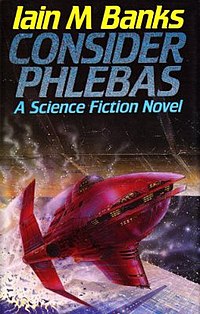
Influences: Consider Phlebas

I thought I’d begin a series of posts about books that have influenced me, so I’m going to start with Iain M. Banks’ Consider Phlebas, his first science fiction novel which came out in 1984 after he’d established himself as a reputed literary author with classics such as The Wasp Factory, Walking on Glass and The Bridge.

A space opera with fast paced action, I was blown away by the scope and ideas of this novel. Although I didn’t think about it much at the time when I first read it (early 1990s) it is one of the first new wave space operas that bridged the gap between old style science fiction where computers were isolated machines that couldn’t do much more than a human could, such as those in a Larry Niven or Isaac Asimov novel, and the cyberpunk movement that exploded out of the 1980s where the whole genre became a playground for ‘grey’ characters, flawed and morally ambiguous characters, as opposed to easily defined good guys and bad guys of the past.

I was drawn by the elegant writing style, the detailed characters especially the protagonist Bora Horza Gobuchul who tries to do the right thing by everyone all the time, but just keeps making a mess of everything he touches, and the rich detail of artificial worlds and bizarre cultures and alien species.

Horza is on a mission during war time, when conflict ravages the entire galaxy reminding me of Star Wars, but in a setting that felt so much more realistic and based more squarely on hard science. I was also drawn by Banks’ most famous contribution to the science fiction canon, the Culture, a vast interstellar utopian society where there are no rules and anything anyone wants is possible, and yet an society that felt compelled to meddle with the affairs of governments and species less civilised than their own.

Banks went on to explore this same setting in future novels such as The Player of Games, Use of Weapons, Excession, Matter and others. I’ve read the entire series but I’ve always been drawn back to Consider Phlebas, partially because it was the first one I read, but mostly because of its vision. It is one of the great space opera novels of the Twentieth Century.