Showing posts with label Space Opera. Show all posts

Thursday, 9 February 2012

"Expectant Green" with John Kenny in Jupiter 35

"Expectant Green", my first collaboration with Irish speculative fiction author and editor, John Kenny, is now available in Jupiter 35, edited by Ian Redman with a terrific cover from Sam Mardon. My first publication for 2012 and its my favorite genre, space opera, and out in print and epub formats. An extract follows:


EXPECTANT GREEN

David Conyers and John Kenny

One hundred days disappeared in a single second while I was dead, or as near dead as you could get without crossing over to that unknown country.
I was in cryosuspension along with twelve-hundred other passengers, encased in the hull of a wormhole transgressor bound for Morrocoy in the Sagan-89 System. Morrocoy was the last place in the galaxy I wanted to be, but I didn’t have a choice in the matter.
  
With that curious sense of dislocation engendered by cryosleep, I opened my eyes and felt, despite an unchanged view of diamond glass and life support readouts, that I was somewhere else.
A familiar face approached; all smiles and warmth.  “Mum!” I cried before I crawled into her arms, held her tight and sobbed.
  
Another woman spoke to me. Her tone sounded cautious. “I’m sorry Ms. Leyton, but I think you’ve mistaken me for someone else.” When I didn’t move, afraid to, the stranger said:  “I’m Nereda Courtemanche, your CS recovery nurse.”
  
I looked up, saw that the woman who held me was no more than a few years my senior. She had a pretty face like my mother, but with freckles and red instead of dark hair worn in a ponytail.
  
“Oh, I am so sorry.”
  
I quickly clambered from of her arms. I couldn’t look at her. I felt like I was about to die.
  
“This is so embarrassing. I’m so sorry.”
  
I tried to run, but tripped on wobbly legs.
  
The nurse caught me. “That’s okay, Francesca.” She supported me gently, sat me down. “Just give yourself a minute. Waking from CS is disorientating for anyone. I felt the same three days ago when I woke.”
   
I glimpsed at Nereda through the corner of my eye. At least I had not imagined her smile, which still beamed for me.
   
“Let me find where your mother is, and I’ll reunite you.”
  
“She’s not here,” I blurted.
  
“Oh. Sorry to hear that.” Nereda clasped her hands together tightly. “You must really miss her?”
I didn’t respond. I should have said something to make her feel better, even if I couldn’t feel that way myself.
  
She scratched the back of her head, her eyes wandered, searched for something other than me to focus on. “Well, you’ve arrived Francesca Leyton. Morrocoy is where you leave us, right?”
  
I nodded.
  
“Is someone waiting to meet you?”
   
“I hope...yes, someone will...meet me.”
   
“Well that’s good. Good luck down there.”
   
Nereda gave me three cups of water, helped me to dress, then left me with one of the ship AI’s extensor bots which made me perform a regime of stretching exercises. By the time I was done I no longer felt disorientated and was ready to tell Nereda the real reason why my mother wasn’t with me, but she was long gone.
  
With remarkable swiftness, given that the transgressor had travelled so many light years across the galaxy for so long, I was processed through customs and security where, despite my protests all my tech items where confiscated from my luggage, and shuttled to the planet’s only spaceport. No one else smiled at me, and all I could feel as the blue-green planet grew large through the view portals was empty and cold.
  
An hour later I was blinking in the bright sunlight, standing in the hot, dusty street watching a motley crew of locals shamble along, dragging pack animals behind them.
   
I thought about what I had wanted to say to the Nereda, but I couldn’t quiet believe what had happened myself. Only three weeks ago subjective time I had been standing over the destroyed body of my mother. The distance I had travelled and the stark contrasts between Mars and this alien planet conspired to place the death of my mother at a remove that seemed almost a lifetime ago. And yet the loss of her was so recent that the reality of her absence had not sunk in; I felt nothing, couldn’t feel anything. Being thrust into this new and foreign environment promised only to extend the duration of my numbness.
   
Sweeping my shoulder length hair back and into a scrunchy, I fished a beaked cap from my travel bag to shade my eyes. Now I could better see the dilapidated sun-scorched wooden buildings that lined the unpaved street that stretched east and west for a couple of hundred metres before meeting walls of dense jungle foliage. Along this stretch a number of streets branched off to the north towards the main part of the town.
   
No sign of my father. Wearily, I unfolded the piece of paper handed to me by the porter as I had exited the building behind me. Oh, great. It gave the name of the hotel where I could find my one surviving parent and directions on how to get there. Heaving a sigh of tiredness and frustration, I hitched my travel bag on my shoulder and marched towards the first turnoff heading north.
   
If I’d told Nereda what had really happened to my mother I would have cried for a very long time. I couldn’t help wondering if I would have felt better now if I had.

Thursday, 14 July 2011

Back to Back Covers for Jupiter

Another of my illustrations will appeared on the cover of the next issue of Jupiter 33: Euanthe.

This illustration I did many years ago, early 2000s from memory. It is a scene from a space opera novel that I've tackled a few times, but never finished. I did that a lot back then, draw scenes from my fiction to get a visual scene of the worlds (or galaxy in this case) that I was creating. I'm excited that the image has made the cover of Jupiter magazine.

The issue features stories by Alexander Hawes, V. K. Valev, Jon Wallace, Shane Ward and Ian Sales, with poetry by Allen Ashley. Out this month I suspect, and probably also available from kindle. Check out Jupiter Magazine for more information.

Friday, 17 June 2011

The Strangest Planets

I've been very interested in the planets astronomers are detecting around other suns. What they are finding is so unexpected, and so different to what we have previously imagined possible.

But is it really that strange? Life seems to evolve and adapt to all kinds of conditions, so why can't planets.

There are Jupiter sized planets out there orbiting so close to their suns their surface temperatures are thousands of degrees. Worlds with extreme eliciptical orbits. Massive rocky planets three times and half a dozen times as massive as the Earth. Planets that are 12 billion years old (consider the Universe is only 13.7 billion years old). Planets that are covered in oceans many hundreds of kilometres thick. Planets, it seems, appear wherever they can survive, just like life.

I feel that strange planets are going to turn space opera on its head. Authors like Larry Niven and Alastair Reynolds are great at creating bizarre worlds, but planets are going to be even more extreme, I think, than what we've seen in the best space opera. It's going to be even more of a challenge to write in this genre now.

Check out this slide show of strange planets at Space.com to see just what it is that astronomers are detecting out there in the Big Black.

Wednesday, 30 December 2009

Plans for 2010: The Space Opera Novel

I don't really know what to write about as an end of year post, but feel that I should do one. Why? Even that question I can't answer. With so much going on in my life outside writing from starting a new job in a new state in the New Year, writing and editing has taken a back seat. When I'm not writing I'm thinking about writing, and currently my thinking has been along the lines of how much I miss writing when I'm not doing it, like the last few months. So I'm looking ahead, to 2010 and what I want to achieve, when I'll be writing again.

So far I have two books lined up to edit for the New Year, both horror, one gaming and one fiction, and both with US publishers. I'll also continue reviewing speculative fiction books for Albedo One and already I have a few I should be emailing to the team in Ireland. I also have a few short stories I want to finish and send off to various magazines to see how I go, mostly science fiction. All of this, well it's happening, what's not happening is... the novel.

Over 2009 I've been reading a lot of new space opera, particularly Alastair Reynolds, and find that although I've always been reading this subgenre of science fiction for a long time, there are always ideas here that excite me even after thirty years of familiarity with the setting. It's what I love reading and what I love writing.

So I've decided 2010 is the year I really need to give my new space opera novel a go, get it done and out to agents and/or publishers. That's the plan, write the novel. It's what every author needs to do if they are ever to become professionals in this game. Will I succeed? Who knows, but with the experience I've had since the last seven years since I wrote my last 100,000 word manuscript, I feel I'm in a much better place to give it a go.

Anyway, I hope everyone out there has the successes they hope for in the new year, and that the future will be exciting and rewarding. And perhaps I'll get to know a whole lot more of you in the writing/editing game now that I'm moving to a new state.

There you go, 2010 is looking great already.

Tuesday, 6 January 2009

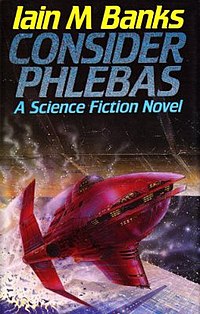
Influences: Consider Phlebas

I thought I’d begin a series of posts about books that have influenced me, so I’m going to start with Iain M. Banks’ Consider Phlebas, his first science fiction novel which came out in 1984 after he’d established himself as a reputed literary author with classics such as The Wasp Factory, Walking on Glass and The Bridge.

A space opera with fast paced action, I was blown away by the scope and ideas of this novel. Although I didn’t think about it much at the time when I first read it (early 1990s) it is one of the first new wave space operas that bridged the gap between old style science fiction where computers were isolated machines that couldn’t do much more than a human could, such as those in a Larry Niven or Isaac Asimov novel, and the cyberpunk movement that exploded out of the 1980s where the whole genre became a playground for ‘grey’ characters, flawed and morally ambiguous characters, as opposed to easily defined good guys and bad guys of the past.

I was drawn by the elegant writing style, the detailed characters especially the protagonist Bora Horza Gobuchul who tries to do the right thing by everyone all the time, but just keeps making a mess of everything he touches, and the rich detail of artificial worlds and bizarre cultures and alien species.

Horza is on a mission during war time, when conflict ravages the entire galaxy reminding me of Star Wars, but in a setting that felt so much more realistic and based more squarely on hard science. I was also drawn by Banks’ most famous contribution to the science fiction canon, the Culture, a vast interstellar utopian society where there are no rules and anything anyone wants is possible, and yet an society that felt compelled to meddle with the affairs of governments and species less civilised than their own.

Banks went on to explore this same setting in future novels such as The Player of Games, Use of Weapons, Excession, Matter and others. I’ve read the entire series but I’ve always been drawn back to Consider Phlebas, partially because it was the first one I read, but mostly because of its vision. It is one of the great space opera novels of the Twentieth Century.