Showing posts with label Novels. Show all posts

Saturday, 24 July 2010

Books that I have read this year

Catching the train to and from work every weekday has dramatically improved my ability to read books. This is what I've read so far:
  • The Prefect, Alastair Reynolds
  • House of Suns, Alastair Reynolds
  • Marrow, Robert Reed
  • Phoenix and the Darkness of Wolves, Shane Jiraiya Cummings
  • Monster Blood Tattoo 1: Foundling, D.M. Cornish
  • Grants Pass, edited by Jennifer Brozek & Amanda Pillar
  • Time, Stephen Baxter
  • The Time Traveller's Wife, Audrey Niffenegger
  • Blood Oil, James Phelan

I am currently reading several books:

  • Inca Gold, Clive Cussler
  • After You'd Gone, Maggie O'Farrell
  • The Best of Best New SF, edited by Gardner Dozois

I've also read a manuscript for Permuted Press which is yet to be released.

Now that I've put a list down in writing it doesn't seem like a lot, about a book and a half a month. I'll see how I go in the latter half of the year, and if I can improve upon this.

Wednesday, 29 April 2009

Influences: Chasm City

I’ve only been reading Alastair Reynolds recently but boy did he make an impression. One of the new wave British science fiction authors who write strong, believable space opera, Reynold’s Revelation Space series is stunning in its scope and imagination.

Chasm City was the first Reynolds novel I read and was the most visually impressive of everythign that I've read by him.
The story centres around two characters. The first is an ex-soldier turned security expert who finds himself on a strange high tech world recovering from the aftermath of a devastating alien plague. His memory is sketchy, but he knows he is chasing a man who wants to kill him to kill him first. The other story concerns a questionable leader of a fleet of slower-than-light starships racing to colonise a distant world, and the coup that results. Both characters are separated by both time and space, but their relationship is closer than anyone might suspect.

Reynolds is influenced by Larry Niven’s Known Space series and it shows in its grand scope and amazing ideas, but what Reynolds does so much better are his characters, his easy to read style and sense of pace. He even has transhumans or posthumans, highly evolved species of men and women who have transgressed the frailness of the human condition, and live almost immortal lives. However unlike many of his contemporaries, Reynold’s posthumans don’t lose their ‘humanness’ with their super abilities.

I also like that high tech is not available for everyone. For example his world of Sky’s Edge is reminiscent of a Latin American country stuck in a perpetual civil war, while his world of Yellowstone is like New Orleans after the cyclone, an amazing vibrant city struck down into squalor after a horrific external event. There are other high tech worlds out there, but they are keeping it to themselves. Unlike many science fiction writers, Reynold’s knows how to build believable political and cultural backdrops to his worlds.

Aliens feature in his stories and they are creepy, enigmatic and highly creative, often with bizarre Lovecraftian like characteristics.

Chasm City is not the only tale in the series, there is also the trilogy Revelation Space, Redemption Ark and Absolution Gap, short story collections Diamond Dog, Turquoise Days and Galactic North, and the stand-alone novel The Prefect. If you like space opera big, exciting and action packed, this is a great series to read.

Tuesday, 6 January 2009

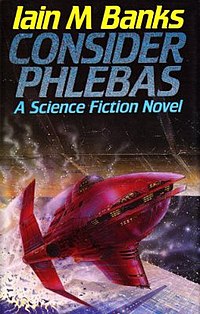
Influences: Consider Phlebas

I thought I’d begin a series of posts about books that have influenced me, so I’m going to start with Iain M. Banks’ Consider Phlebas, his first science fiction novel which came out in 1984 after he’d established himself as a reputed literary author with classics such as The Wasp Factory, Walking on Glass and The Bridge.

A space opera with fast paced action, I was blown away by the scope and ideas of this novel. Although I didn’t think about it much at the time when I first read it (early 1990s) it is one of the first new wave space operas that bridged the gap between old style science fiction where computers were isolated machines that couldn’t do much more than a human could, such as those in a Larry Niven or Isaac Asimov novel, and the cyberpunk movement that exploded out of the 1980s where the whole genre became a playground for ‘grey’ characters, flawed and morally ambiguous characters, as opposed to easily defined good guys and bad guys of the past.

I was drawn by the elegant writing style, the detailed characters especially the protagonist Bora Horza Gobuchul who tries to do the right thing by everyone all the time, but just keeps making a mess of everything he touches, and the rich detail of artificial worlds and bizarre cultures and alien species.

Horza is on a mission during war time, when conflict ravages the entire galaxy reminding me of Star Wars, but in a setting that felt so much more realistic and based more squarely on hard science. I was also drawn by Banks’ most famous contribution to the science fiction canon, the Culture, a vast interstellar utopian society where there are no rules and anything anyone wants is possible, and yet an society that felt compelled to meddle with the affairs of governments and species less civilised than their own.

Banks went on to explore this same setting in future novels such as The Player of Games, Use of Weapons, Excession, Matter and others. I’ve read the entire series but I’ve always been drawn back to Consider Phlebas, partially because it was the first one I read, but mostly because of its vision. It is one of the great space opera novels of the Twentieth Century.